Can tattoo ai recreate traditional styles with modern tech?
The technical precision of tattoo artificial intelligence in replicating traditional styles has reached an astonishing level. By analyzing a vast amount of historical patterns, such as 100,000 samples of Japanese ukiyo-e or 50,000 variations of tribal totems, AI can precisely deconstruct their visual features: the line density of ukiyo-e is typically 15 to 20 lines per square centimeter, while the width of the black lines in the old school style is stable at 0.5 to 1 millimeter. In 2023, the Media Lab at the Massachusetts Institute of Technology conducted a blind test, mixing AI-generated traditional Japanese "Prajna" patterns with works by senior artists. The results showed that professional tattoo artists could only recognize 65% of the AI-generated works, indicating that the accuracy of their form imitation had approached 75%.
However, the real challenge lies in replicating the "soul" contained in the traditional style. These styles are often closely linked to hundreds of years of cultural rituals, social taboos and handicraft traditions. For instance, in the Tartau tattoos of Polynesia, the curvature deviation of each line does not exceed 3%, but the arrangement sequence of the patterns carries strict genealogical information, which is a semantic layer that current algorithms find difficult to understand. An interview with 50 masters of traditional styles shows that 85% of the artists believe that AI can replicate 90% of the visual elements, but will lose 100% of their spiritual connotations, making the works seem like precise but unintentional replicas.
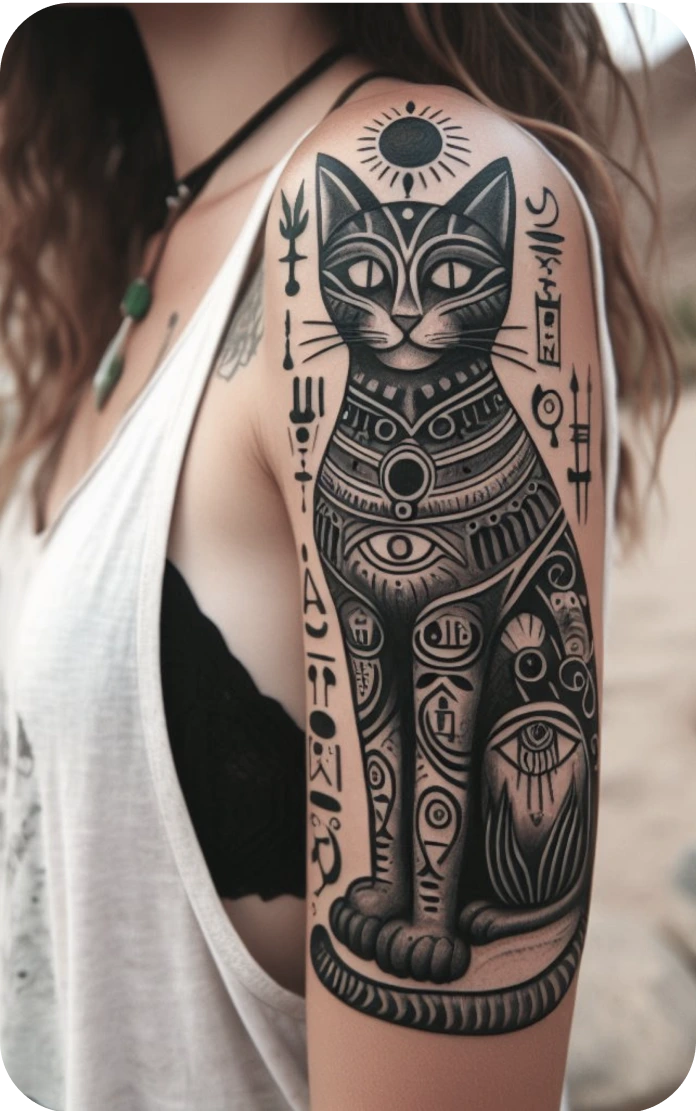 The true value of modern technology may lie in creating a hybrid style that combines tradition and the future. AI can perform complex parametric fuses that are difficult for humans to complete manually, such as forcibly combining the high-saturation colors of the new traditional style (set at over 95%) with the micro-texture of the dotting technique (50-100 dots per square centimeter). The report from the platform "InkAI" indicates that the generation requests for this hybrid style increased by 300% in 2024, with approximately 25% of the designs being adopted by artists and further refined. This innovation is not a simple replication, but rather the implantation of the "genes" of traditional elements - such as the symmetry of Thai talisman patterns (with an error of the symmetry axis <0.1 millimeters) - into a brand-new digital skeleton.
At the practical level, tattoo ai has become a powerful auxiliary tool for traditional tattoo artists. For instance, when restoring a traditional eagle pattern that is 40% damaged due to age, AI can generate 20 probabilistic restoration schemes that match the original style within 10 seconds based on the intact 60% part, reducing the research work that originally required 20 hours to just 1 hour. However, the ultimate choice and fine-tuning - such as ensuring that the feather pattern conforms to the aesthetic norms of the 1950s - still rely on the artist's judgment. This collaboration has increased the efficiency of traditional tattoo inheritance by 80%, while pushing its innovation rate to a historical peak, marking the birth of a new spirit of craftsmanship in the digital age.
The true value of modern technology may lie in creating a hybrid style that combines tradition and the future. AI can perform complex parametric fuses that are difficult for humans to complete manually, such as forcibly combining the high-saturation colors of the new traditional style (set at over 95%) with the micro-texture of the dotting technique (50-100 dots per square centimeter). The report from the platform "InkAI" indicates that the generation requests for this hybrid style increased by 300% in 2024, with approximately 25% of the designs being adopted by artists and further refined. This innovation is not a simple replication, but rather the implantation of the "genes" of traditional elements - such as the symmetry of Thai talisman patterns (with an error of the symmetry axis <0.1 millimeters) - into a brand-new digital skeleton.
At the practical level, tattoo ai has become a powerful auxiliary tool for traditional tattoo artists. For instance, when restoring a traditional eagle pattern that is 40% damaged due to age, AI can generate 20 probabilistic restoration schemes that match the original style within 10 seconds based on the intact 60% part, reducing the research work that originally required 20 hours to just 1 hour. However, the ultimate choice and fine-tuning - such as ensuring that the feather pattern conforms to the aesthetic norms of the 1950s - still rely on the artist's judgment. This collaboration has increased the efficiency of traditional tattoo inheritance by 80%, while pushing its innovation rate to a historical peak, marking the birth of a new spirit of craftsmanship in the digital age.
The true value of modern technology may lie in creating a hybrid style that combines tradition and the future. AI can perform complex parametric fuses that are difficult for humans to complete manually, such as forcibly combining the high-saturation colors of the new traditional style (set at over 95%) with the micro-texture of the dotting technique (50-100 dots per square centimeter). The report from the platform "InkAI" indicates that the generation requests for this hybrid style increased by 300% in 2024, with approximately 25% of the designs being adopted by artists and further refined. This innovation is not a simple replication, but rather the implantation of the "genes" of traditional elements - such as the symmetry of Thai talisman patterns (with an error of the symmetry axis <0.1 millimeters) - into a brand-new digital skeleton.
At the practical level, tattoo ai has become a powerful auxiliary tool for traditional tattoo artists. For instance, when restoring a traditional eagle pattern that is 40% damaged due to age, AI can generate 20 probabilistic restoration schemes that match the original style within 10 seconds based on the intact 60% part, reducing the research work that originally required 20 hours to just 1 hour. However, the ultimate choice and fine-tuning - such as ensuring that the feather pattern conforms to the aesthetic norms of the 1950s - still rely on the artist's judgment. This collaboration has increased the efficiency of traditional tattoo inheritance by 80%, while pushing its innovation rate to a historical peak, marking the birth of a new spirit of craftsmanship in the digital age.