Portable Sunscreen Sticks: Why Format Decides Reapplication
A sunscreen only works while it is on the skin, so the format often decides more than the formula does. The protected time published on the client site is about 450 minutes for SPF30 and about 750 minutes for SPF50, each built from 15 minutes of unprotected exposure. A stick that lives in a pocket is applied again; a bottle left at home is not. This article looks at why the portable format changes user behaviour.
Key takeaways
- Published protected time is about 450 minutes for SPF30 and about 750 minutes for SPF50.
- Both figures assume 15 minutes of unprotected exposure as the base unit.
- A stick is applied directly to the skin, so it fits reapplication during travel and outdoor activity.
- Packaging compatibility should be tested with the final component, not a laboratory jar.
Reapplication is the product
Most sunscreen discussion starts with the formula and the SPF value. That is backwards for a product that is meant to be worn for hours. The published windows assume the product is applied and then left to work. Every hour beyond that window is an hour the user has to do something about it, and users who cannot reach the product simply do not act.
That is why format carries so much weight. A stick is a solid or semi-solid product applied directly to the skin. There is no pump, no cap to unscrew over a bag, and no liquid to spill. The shorter the gap between noticing and reapplying, the more often the second application actually happens, and the closer the real routine gets to the published window.
What a stick changes about a routine
A traditional bottle is a planned purchase and a planned action. It sits in a bag, and it comes out when someone stops walking, finds shade and frees both hands. A stick is an unplanned action. It can be drawn across the face in a few seconds while waiting for a bus or standing at the edge of a field, and that difference shows up in how often the product is used.
The format also decides where the product is likely to be kept. A stick sits in a jacket pocket, a glovebox or a carry-on, close to the skin it is meant to protect. Proximity is not a marketing claim; it is the practical reason a portable format supports a reapplication message better than a large bottle, and the development route for the format is set out in the private label sunscreen stick guide.
The published protected-time numbers
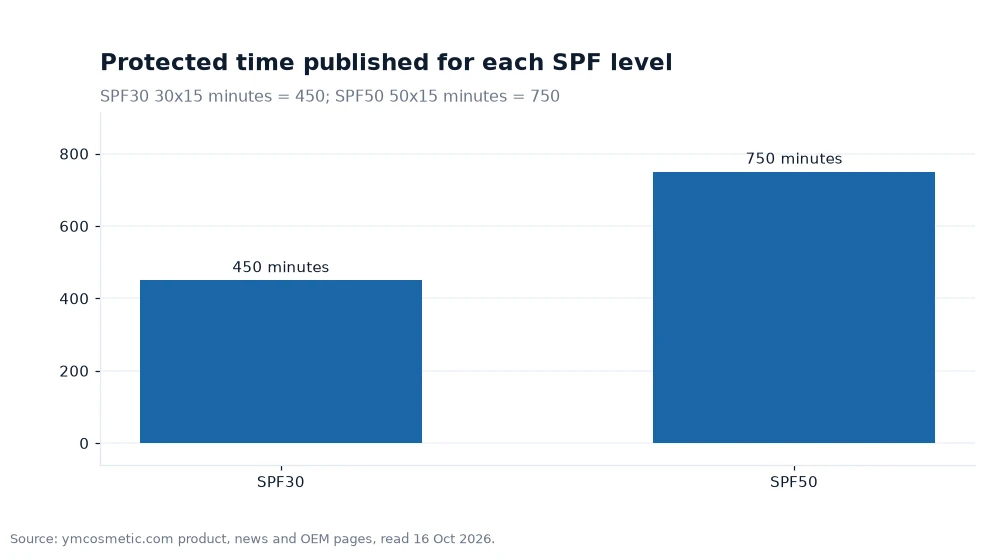
The client site publishes protected time for the two common SPF levels. SPF30 is listed at about 450 minutes, and SPF50 at about 750 minutes. Both are built the same way: they take the SPF number and multiply it by 15 minutes of unprotected exposure. That gives 30 × 15 = 450 and 50 × 15 = 750.
Read as hours, 450 minutes is 7.5 hours and 750 minutes is 12.5 hours. The gap between the two is 300 minutes, or 5 hours. A brand that sells a stick on the strength of a longer window should know that the extra 5 hours only matters if the user is outdoors long enough to notice, and that a single reapplication resets the clock regardless of the SPF value printed on the label.
Why a portable format gets used more often
The advice to reapply sun protection is easy to publish and hard to follow. The barrier is rarely knowledge; it is friction. A format that removes friction gets used. A format that adds steps, such as returning to a bag or squeezing a tube with suncream-covered hands, tends to be skipped at exactly the moment it is needed.
The client site lists lotion, stick, spray and gel as the formats a brand can consider. For a reapplication-led range, the stick is the one designed around a quick, direct application to the skin. That does not make the others weaker; it means the format should be chosen for the behaviour the brand wants to encourage. A detailed look at the portable sunscreen stick format sits alongside that wider guide and explains where it fits.
| SPF level | Calculation | Published protected time |
|---|---|---|
| SPF30 | 30 × 15 minutes | About 450 minutes (7.5 hours) |
| SPF50 | 50 × 15 minutes | About 750 minutes (12.5 hours) |
| Difference | 750 − 450 | 300 minutes (5 hours) |
Worked example: a ten-hour day with one reapplication
Take a ten-hour day outdoors, which is 10 × 60 = 600 minutes of exposure. An SPF30 stick is published at 450 minutes, so a single morning application covers 450 of the 600 minutes and leaves 600 − 450 = 150 minutes, or 2.5 hours, outside the stated window. An SPF50 stick at 750 minutes clears the day on its own, with 750 − 600 = 150 minutes of margin. Now change one variable: if the user reapplies the SPF30 stick once, at the midpoint, the window resets and covers 450 + 450 = 900 minutes, which clears the 600-minute day with 900 − 600 = 300 minutes to spare.
That single comparison is the whole format argument. One extra application turns a 150-minute shortfall into a 300-minute surplus, and the product that makes the extra application easy is the one that gets it. The formula still has to be sound, and the SPF value still has to match the claim, but the behaviour is what closes the gap between the published window and the day the user actually has.
Reading the chart
Two bars carry the message. SPF30 reaches 450 minutes and SPF50 reaches 750, so the taller bar sits 300 minutes above the shorter one. Those two numbers are the ones to keep in the brief, because they set the length of the day the product can plausibly cover before the user has to act again.
The chart is deliberately short. It is not a ranking of quality; it is a pair of windows. The practical reading is that a stick priced around SPF50 buys more time per application, while a stick at SPF30 leans harder on the habit of reapplying. Whichever bar a brand chooses, the portable format is what makes the second application realistic.
Frequently asked questions
How long is the protected time published for SPF30 and SPF50?
The client site publishes about 450 minutes for SPF30 and about 750 minutes for SPF50, each calculated from 15 minutes of unprotected exposure.
What makes a stick easier to reapply than a bottle?
A stick is a solid or semi-solid format applied directly to the skin, so it is portable and convenient for reapplication during travel and outdoor activity, with fewer steps than opening a bottle or tube.
Does a higher SPF remove the need to reapply?
It extends the published window but does not remove the need to act. SPF50 is published at about 750 minutes, yet on a longer day a single application still leaves time uncovered, and one reapplication resets the window.
Getting a stick ready for production
From a production view, sticks need attention to formula structure and filling performance, so the format is not simply a bottle in a different shape. Yunmei supports this work as an OEM/ODM partner, and packaging compatibility should be tested with the final component rather than a laboratory jar. A brand can review the wider sunscreen cream and spray range to see how the stick sits next to other formats before committing to a sample.
Order minimums, route windows and factory figures were sourced from the manufacturer's own pages on 16 Oct 2026.[1]